n his highly entertaining and incisive book The Old Patagonia Express, describing his journey south by rail from
Massachusetts to Tierra del Fuego, Paul Theroux portrays a litany of places one might want to avoid. But Costa Rica is different. One of his characters sums it up. Freshly arrived in San Jose, the capital city, Theroux
finds himself talking to a Chinese man in a bar. The Asian--a Costa Rican citizen--had left his homeland in 1954 and traveled widely throughout the Americas. he disliked every country he had seen except one. "What about
the United States?" Theroux asked. "I went all around it," replied the Chinese man. "Maybe it is a good country, but I don't think so. I could not live there. I was still traveling, and I thought to myself, 'What is the
best country?' It was Costa Rica--I liked it very much. So I stayed."At first sight, Costa Rica appears almost too good to be true. The temptations and appeals of this tiny nation are so many than an estimated 30,000
North American citizens (more than one percent of Costa Rica's population) have moved here in recent years and now call Costa Rica home, attracted by financial incentives and a quality of life among the highest in the
Western Hemisphere. Pensionados
and other foreigners-in-residence are privy to what travelers only recently wised up to... Costa Rica is one of the world's best-kept travel secrets, as well as a great place to live.
For years travelers had
neglected this exciting yet peaceful nation primarily because of a muddled grasp of Central American geo-politics. While its neighbors have been racked by turmoil, Costa Rica has been blessed with a remarkable normalcy:
few extremes of wealth and poverty, no standing army (the army was disbanded in 1948 by the man who led the revolution), and a proud history as Central America's most stable democracy.
Ticos, as the friendly Costa
Ricans are known, pride themselves on having more teachers than policemen, a higher male life expectancy than does the United States, an egalitarianism and strong commitment to peace and prosperity, and an education and
soclal-welfare system that should be the envy of many developed nations. Even the smallest town is electrified, water most everywhere is potable, and the telecommunications system is the best in Latin America. In 1990,
the United Nations declared Costa Rica the country with the best human-development index among underdeveloped nations; in 1992 it was taken off the list of underdeveloped nations altogether. No wonder
National Geographic called it the "land of the happy medium."
Despite its diminutive size (about the same as West Virginia), Costa Rica proffers more beauty and adventure per acre than any other country on earth.
It's a kind of microcontinent unto itself. The diversity of terrain is remarkable, most of it as supremely beautiful as Mother Nature ever intended, and sculpted to show off the full potential of the tropics. Anyone who
wants to journey, as it were, from the Amazon to a Swiss alpine forest has simply to start at the coast and start walking uphill. Within a one-hour journey from San Jose, the capital city, the tableau changes with
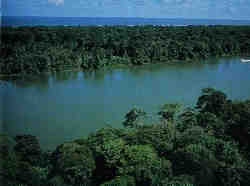
dramatic effect through dense rainforest, airy deciduous forest, and montane cloud forest that swathe the slopes of towering volcanoes, to dry open savanna, lush sugarcane fields, banana plantations, and rich cattle
ranches set in deep valleys, and to rain-soaked jungle, lagoons, and estuaries... all of them teeming with wildlife. The lush rainforest spills down the mountain slopes to meet the Pacific and Atlantic oceans, where
dozens of inviting beaches remain unspoilt by Man Friday footprints, and in places offshore coral reefs open up a world more beautiful than a casket of gems.
Though the history buff may be disappointed by the lack of
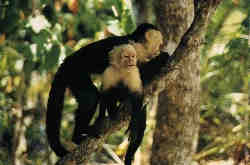
pre-Columbian or colonial sites and structures, Costa Rica's varied ecosystems are a naturalist's dream. Unlike many destinations, where man has driven the animals into the deepest backwater seclusion, Costa RIca's
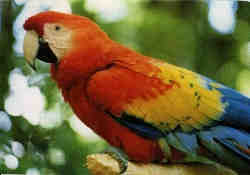
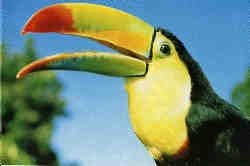
wildlife loves to put on a song and dance. Animals and birds are prolific, and in many cases easily seen: sleek jaguars on the prowl, sloths with smiles like Muppets moving languidly among the high branches, scarlet
macaws that fall from their perches and go
squalling away, toucans, brightly-colored tree frogs, and other exotic species in abundance. That sudden flutter of blue is a giant morpho butterfly, that mournful two-note
whistle, the quetzal, the Holy Grail of tropical birds. The pristine forests are full of arboreal sounds. You can almost feel the vegetation growing around you. There is a sense of life at flood tide.
The nation's 12
distinct ecological zones are home to an astonishing array of flora and fauna--approximately five percent of all known species on earth in a country that occupies less than three ten-thousandths of its land
area--including more butterfly species than the whole of Africa, and more than twice the number of bird species as the USA. Stay her long enough and you'll begin to think that with luck you might, like Noah, see all the
creatures on earth.
Scuba divers, fishermen, golfers, spa addicts, kayakers and whitewater rafters, hikers, surfers, honeymoon romantics, and every other breed of escape artist can find their nirvana in Costa Rica.
The adventure travel industry has matured into one of the world's finest under the tutelage of experienced North American operators. About the only adventure activities not possible are those that involve snow skis or
camels.
For better or worse, Costa Rica is also blossoming as a contender on the international beach-resort scene. The nation's Pacific Northwest coast offers miles of talcum-fine, sugar-white beaches. Deluxe resorts
are sprouting like mushrooms on a damp log... though they are vastly outnumbered by rustic lodges and cabins where, lazing in a hammock dramatically overlooking the beach, you might seriously contemplate giving it all
up back home and settling down to while away the rest of your days enjoying the never-winter climate.
Fortunately, as yet there are no Acapulcos or Cancuns scarring the coast. Still, Costa Rica's progressive
conservationist tradition is under threat.
The country is finally having to face a paradoxical problem: that of being loved to death. As the word spreads, the more people come. The more, too, the big developers are
drawn. I hope it will be many years before Costa Rica is spoiled, but I say... GO NOW!